Performance Marketing: Why AI Has (Already) Won the Attention War on Facebook Ads
The creative instinct is no longer enough on Facebook Ads. In 2026, AI analyzes where humans feel. Discover why the algorithm has won the war for attention — and how to become the one in control again.
The Decline of Intuition: Why the "Creative Instinct" Is No Longer Enough Against Algorithms
For decades, performance marketing relied on "flair." An art director and a media buyer would come together to bet on an idea, a visual concept, or a tagline, hoping it would resonate with the audience. In 2026, this model is officially obsolete.
The problem? Human instinct is biased by culture, mood, and personal aesthetic preferences. In contrast, the Facebook Ads algorithm (via Advantage+) "feels" nothing: it analyzes. Where a creator sees a beautiful image, AI sees a matrix of pixels correlated to conversion probabilities.
The End of "It's Pretty" in Favor of "It Converts"
AI has transformed advertising creativity into a data science. Here's why human intuition is losing ground:
- Granular Analysis of Signals:AI identifies patterns invisible to the naked eye. It knows if, for your target audience, a product should be placed on the left or right of the image, or if a specific shade of blue generates an additional 0.05% click-through rate.
- Emotional Neutrality:A human creator becomes attached to their creations. AI, however, has no ego. If a visual it generated in 3 seconds outperforms a video produced in two weeks by an agency, it will instantly cut the video's budget without any remorse.
- Speed of Correlation:The algorithm cross-references user browsing behavior with the visual composition of your ad in real-time.
The finding is stark: on Facebook Ads, creativity is no longer an art of expression; it's a mathematical optimization problem. Humans create to please; AI assembles to make people act.
Now, the success of a campaign no longer depends on the brilliant "big idea," but on the ability to feed the machine with enough variations for it to find the winning combination on its own.
The End of Manual A/B Testing: How AI Advantage+ Generates 1000 Variations Before Your First Coffee
Not long ago, testing an ad required rigor and, above all, time. One would isolate a variable—a button color, a title, an audience—and patiently wait for the data to become statistically significant. Today, this method resembles trying to empty the ocean with a teaspoon.
Granular Automation: "Dynamic Creative" on Steroids
Meta's AI no longer just tests two versions of an image. It deconstructs every element of your ad (title, body text, visual, call to action) to recombine them in real-time.
- Permanent Multidimensional Testing:Where a human laboriously tests 4 variants, AI deploys hundreds. It can present a minimalist version to a rushed mobile user and a detailed version with testimonials to another user in the research phase on a computer.
- Latency-Free Execution:AI detects Ad Fatigue before your ROI curve even starts to drop. Before you can open your ad manager, it has already injected a new variation to maintain performance.
Why Humans Have Become the Bottleneck
The main barrier to performance in 2026 is the speed of human production. A video editor will take 4 hours to adapt a 9:16 format to 1:1. AI does it in 0.4 seconds, dynamically adjusting the framing to keep the product always at the center of attention.
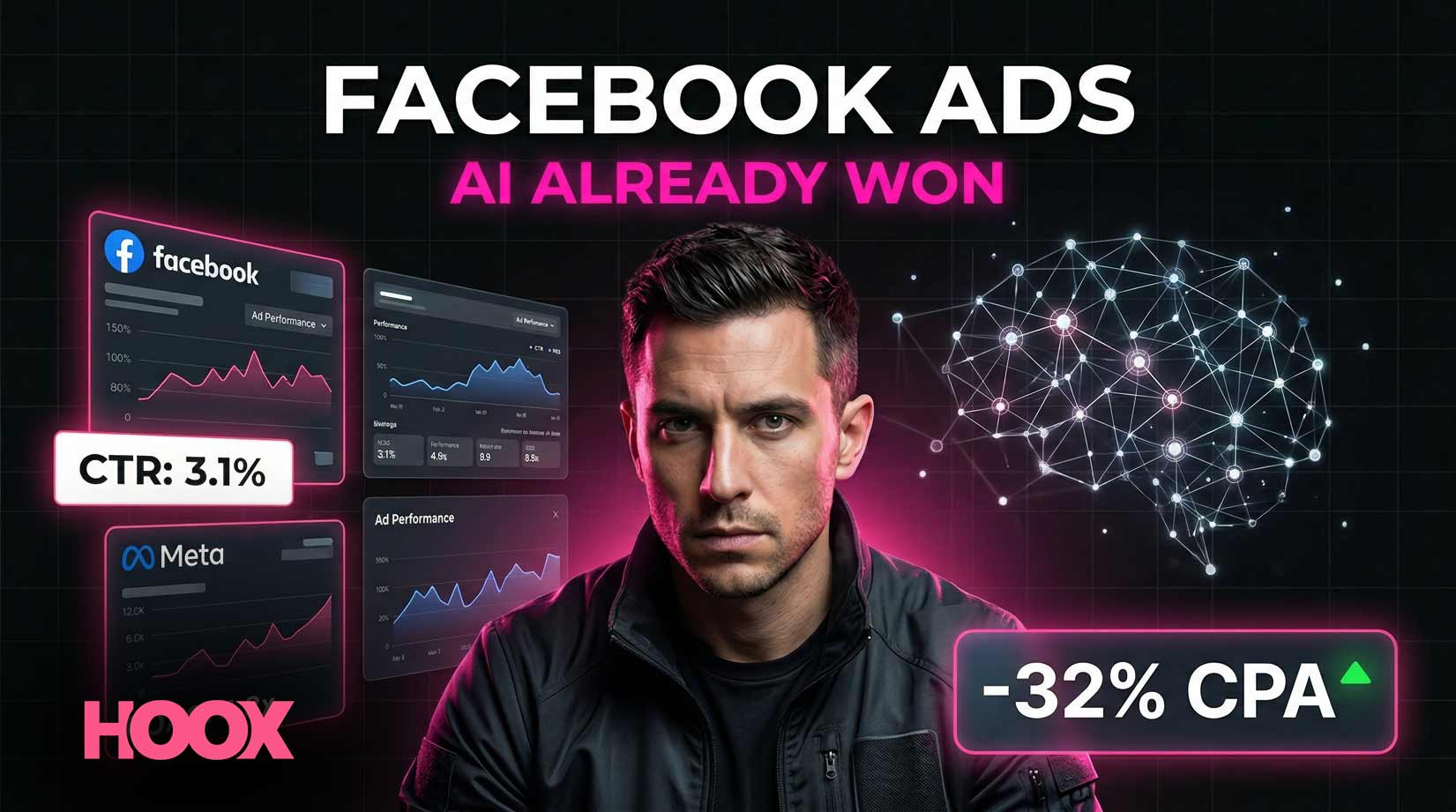
The Key Figure: Campaigns using AI-automated testing structures show an average 32% reduction in cost per action (CPA) compared to manual structures.
The Unfair Advantage of "Computer Vision": What AI Sees That Your Designer Ignores
If you still think Meta's algorithm merely reads your tags and keywords to distribute your ads, you're a war behind. In 2026, Computer Vision is the secret weapon that allows AI to outclass human creators. It doesn't look at your ad: it scans it like a database.
Semantic Reading of Pixels
AI breaks down each visual into thousands of data points. It instantly identifies:
- Visual Hierarchy:Where does the eye land in a millisecond? AI calculates luminance contrast to ensure your product is the first thing perceived, well before the user's conscious brain processes the information.
- Real-Time Color Psychology:Unlike a human who chooses a color for its "beauty," AI adjusts colorimetry based on the user's flow. If the user has just scrolled through ten dark photos, AI can boost saturation to create an immediate Pattern Interrupt.
- Analysis of Micro-Expressions:On ads using human faces, AI detects the exact degree of confidence or enthusiasm projected and correlates it with past conversion rates on that specific audience.
"Creative Scoring": Predicting Success Before Broadcast
AI's greatest advantage lies in its predictive capability. Even before your ad is shown to the first user, AI assigns it a visual relevance score. Meta uses convolutional neural networks to compare your creation to billions of other successful ads. If your designer bets on pure originality, AI bets on neural resonance.
Human Creator Approach vs. AI Approach:
- Framing — Human:Aesthetic and balanced. AI: Optimized for the focal point of the gaze.
- Text on Image — Human:Readability and style. AI: Pixel density and OCR contrast.
- Emotion — Human:"It touches me." AI: Statistical correlation with the click.
The Performance Paradox: AI Beats Humans on ROI, But at What Cost to Your Brand Image?
If AI wins on short-term numbers, it poses an existential dilemma for brands: standardization. By optimizing for immediate clicks, the algorithm ends up smoothing out all uniqueness. This is called the "Performance Paradox" in 2026.
The Risk of "Visual Average"
Meta's AI is programmed for one goal: conversion. To achieve this, it draws on what has already worked for thousands of other advertisers. The result? A "visual soup" where all ads start to look alike. If AI detects that a certain type of font and a specific background color convert better, it will apply them to your luxury brand as well as to a detergent brand. In the long run, your company's visual identity fades behind the algorithm's efficiency.
Performance vs. Branding: The Conflict of Objectives
Humans understand that an ad shouldn't just sell; it should tell a story and build a memory. AI, however, has no brand memory; it only has session memory. A 100% AI-driven campaign can generate exceptional ROI for three months while destroying the brand's goodwill through aggressive repetition and generic visuals. This is called the "Dehumanization of the Funnel."
AI is a Sniper, Humans are the Architects
AI excels at converting an already warm audience, but it is often incapable of creating "desire" from scratch. It knows how to respond to demand; it does not yet know how to create cultural aspiration.
- Humans Create the Context:Tone of voice, ethics, quirky humor.
- AI Creates the Impact:Framing, timing of broadcast, displayed price.
Strategy 2026: How to Steer AI Rather Than Fight It
The debate is no longer about whether AI will replace creators, but understanding that the creator who uses AI will replace the one who does not. In 2026, the role of "Media Buyer" or "Advertising Designer" merges to give birth to a new key function: the Creative Strategist.
Moving from Execution to Conducting
The human role is no longer to draw every pixel but to ensure coherence and innovation. The machine is a prodigious executor, but it remains blind without clear direction.
- Strategic "Prompt Engineering":The creator becomes the one who injects cultural concepts, deep psychological insights, and brand nuances that AI cannot guess on its own.
- Ethical and Qualitative Control:Humans must act as a filter to avoid AI Slop (mediocre content generated en masse) that could degrade the brand image.
- Disruptive Innovation:AI optimizes the existing, but it rarely invents new codes. Humans retain the monopoly on "thinking outside the box," absurd humor, or pure emotion that creates tomorrow's trends.
The New Winning Workflow
- Humans Identify the Insight:"Our customers fear planned obsolescence."
- AI Generates 50 Visual Angles:It translates this concept into videos, statics, and carousels in minutes.
- The Algorithm Tests and Deploys:Meta Advantage+ finds the combination that resonates with each audience segment.
- Humans Analyze and Pivot:The strategist interprets the results to feed the next big idea.
The Competitive Edge of 2026: It's not about having the best AI, but having the human who knows how to ask the best questions to the machine.
Conclusion: Victory Through Symbiosis
AI beats human creators in speed, precision, and immediate ROI. It's a mathematical fact. But it remains a powerful engine without a steering wheel. By entrusting technical optimization to the algorithm, marketers finally rediscover their original mission: understanding humans and telling stories that matter.