AI UGC: What It Is, Benefits, and Digital Marketing Use Cases
Discover AI UGC: What it is, how it boosts digital marketing, and its top use cases — social ads, landing pages, emails, creative testing, and global expansion.
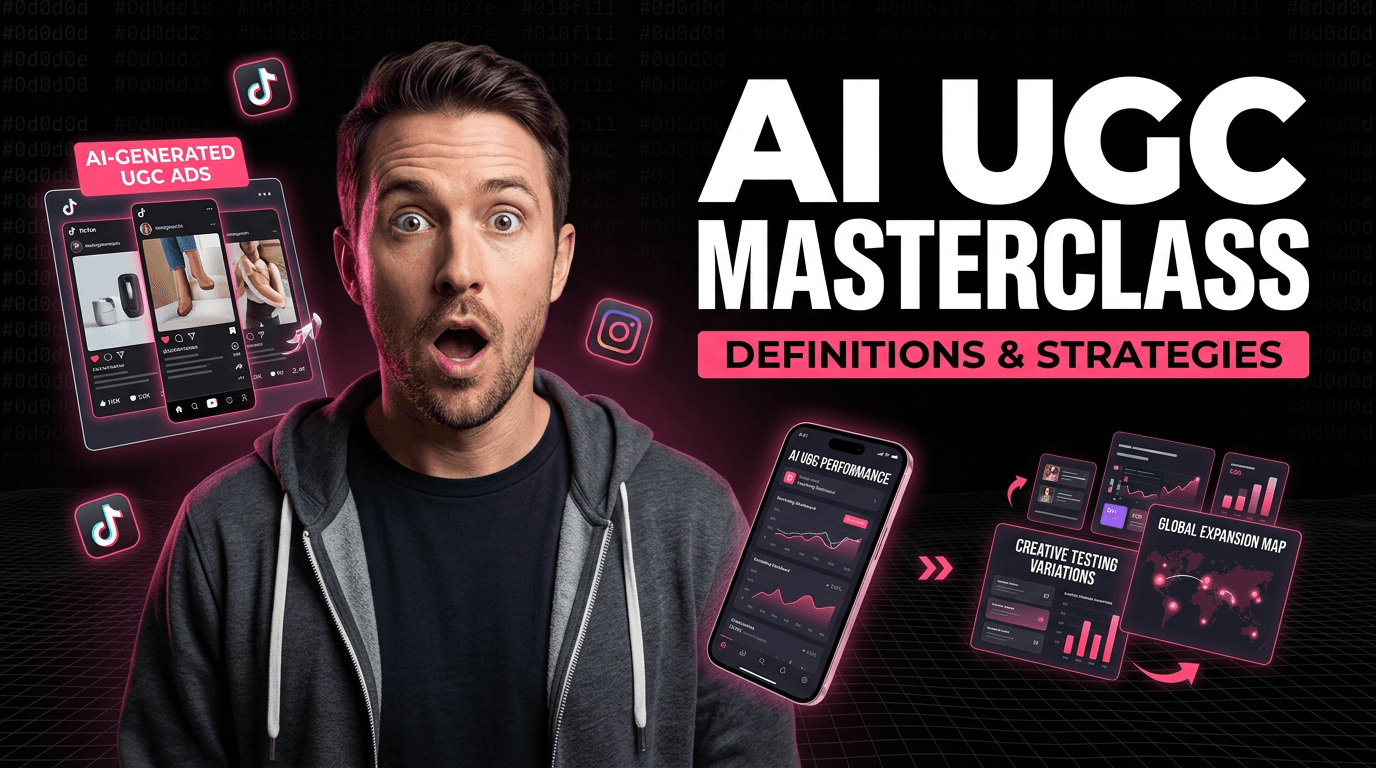
AI UGC (Artificial Intelligence User Generated Content) refers to video or visual content that mimics the authentic style of user-generated content, but is entirely produced by artificial intelligence. This format enables marketing teams to create ads with an organic look, without filming or human creators, while cutting production costs by an average of 23%, according to Aspire. By 2025, 63% of marketers plan to integrate AI into their influencer campaigns, making AI UGC a must-have strategic asset.
What exactly is AI UGC?
Traditional UGC relies on real users or creators filming testimonials, unboxings, or product reviews. AI UGC replicates this format using AI-generated avatars, synthetic voices, and automated scripts.
In practice, an AI UGC video looks like content filmed by a real consumer, with a face-to-camera setup, a conversational tone, and spontaneous staging. The difference: everything is produced by software, in just minutes, without casting or post-production.
This format stands apart from three other approaches:
- Classic UGC, created by real users or micro-influencers
- IGC (Influencer Generated Content), produced by paid creators
- Brand content, crafted internally by the brand with strong artistic direction
AI UGC borrows the perceived authenticity of UGC and IGC while offering the complete control of brand content. To delve deeper into how AI-generated UGC videos work, it's essential to understand the voice synthesis, face generation, and lip-sync models that make these videos believable.
The tangible benefits of AI UGC for digital marketing
Reduced production costs and timelines
Producing traditional UGC involves finding a creator, negotiating a brief, waiting for the shoot, and approving the footage. AI UGC eliminates all these steps. According to Aspire, brands repurposing content via AI cut their creation costs by 23%. Production time shrinks from several days to just minutes.
Superior ad performance
Data shows a clear gap between UGC/IGC-style content and traditional brand content:
- CPA drops by 30% with influencer-type content compared to brand-produced content (Aspire)
- 60% of marketers find influencer-generated content outperforms brand-directed content (Aspire)
- On Instagram, the average ROI for influencer campaigns is $4.12 for every dollar spent (Aspire)
AI UGC inherits these performance levels while removing logistical constraints. For a detailed performance gap analysis, check out the comparison AI UGC vs Traditional UGC.
Unlimited scaling capability
The main limitation of traditional UGC is volume. You're dependent on the number of available creators, their responsiveness, and their ability to produce variations. With AI UGC, you can generate dozens of versions of the same video by changing the avatar, script, tone, or hook. It's exactly what you need for large-scale A/B testing.
Influencer marketing budgets increased by 171% between 2024 and 2025 according to the Influencer Marketing Benchmark Report. This growth drives teams to seek solutions that can keep pace, and AI UGC directly addresses this need.
Total message control
Unlike traditional UGC, where the creator retains some interpretive freedom, AI UGC gives you absolute control over every word, intonation, and shot. You stay true to your brand positioning without sacrificing perceived authenticity.
AI UGC use cases in digital marketing
Social ads (Meta, TikTok, YouTube)
This is the most common use case. AI UGC videos with a face-to-camera format perform particularly well on Meta Ads and TikTok Ads, where the algorithm favors content that looks native. You can quickly produce varied hooks to find the ones that capture attention best, then scale the winners.
Product pages and landing pages
Embedding an AI UGC video on a product page or landing page increases time spent and conversions. Data from Similarweb shows users from AI platforms spend an average of 15 minutes per site, compared to 8 minutes from Google, and convert at 7% versus 5%. Authentic video content amplifies this effect.
Email sequences and retargeting
An AI UGC video in a follow-up email or nurturing sequence adds a human touch that text alone can't provide. You can personalize the message by segment without multiple shoots.
Product launches and market testing
Before investing in a large-scale campaign, AI UGC allows for quick testing of various creative angles. You create five variants in an hour, release them on a limited budget, and identify which message resonates best with your audience.
Brands expanding internationally
AI UGC simplifies content localization. You adapt the script to the target language, select an avatar that fits the market, and get a localized video without hiring a local creator. This is one reason why more brands are scaling their AI UGC campaigns internationally.
The AI UGC market in 2025: stats and trends
The global influencer marketing market is set to reach $32.55 billion in 2025, a 35% increase from 2024 according to Statista. AI is emerging as a key driver of this growth.
Key indicators:
- 36.67% of teams already use AI for creator discovery (Influencer Marketing Benchmark Report)
- 37% of consumers say they're more interested in a brand using an AI influencer, rising to 46% among Gen Z (Aspire)
- Experimenting with AI-generated content is among the top priorities for social marketers in 2026 (Sprout Social)
- 84% of brands find influencer marketing effective, and 50% allocate up to half of their marketing budget to it (Aspire)
Product discovery itself is transforming: 35% of American consumers use AI for product discovery, compared to just 13.6% through traditional search according to Similarweb. Brands producing content optimized for these new channels are gaining a competitive edge.
How to integrate AI UGC into your strategy
Implementation doesn't require overhauling your entire marketing stack. Here's a gradual approach:
- Identify your winning creative angles from existing UGC or ad campaigns
- Produce AI UGC variants by testing different avatars, hooks, and lengths
- Launch A/B campaigns on your main channels (Meta, TikTok, YouTube)
- Analyze performance (CPA, CTR, ROAS) and iterate quickly
- Scale winning creatives by multiplying variations
Hoox covers all these steps from a single interface. You choose or customize an AI avatar, write your script or let AI generate it, and get a video ready to deploy in minutes. Production is fully automated, allowing you to create dozens of variants without additional resources.
FAQ
What's the difference between AI UGC and traditional UGC?
Traditional UGC is filmed by real users or creators. AI UGC mimics this style with AI-generated avatars and voices, offering total control and near-instant production.
Is AI UGC as effective as traditional UGC in advertising?
Data shows UGC/IGC-style content reduces CPA by 30% compared to brand content according to Aspire. AI UGC inherits this performance while enabling much higher production volumes.
Do consumers trust AI-generated content?
37% of consumers say they're more interested in a brand using an AI influencer, with this figure rising to 46% among Gen Z according to Aspire. Perception is evolving rapidly, especially among younger audiences.
What are the best use cases for AI UGC?
Social ads (Meta, TikTok), product pages, email sequences, product launches, and international expansion are the most common and effective use cases.
Conclusion
AI UGC is no longer an experiment. It's becoming a staple in the marketing strategies of top-performing teams. Cost reduction, creative scaling, measurable ad performance: the benefits are clear and documented.
If you want to try AI UGC for your next campaigns, Hoox lets you produce your first videos in minutes, with customizable avatars and no filming constraints. It's the fastest way to go from idea to published creative.